



Write Learning Objectives That Actually Work
Ever feel like you’re creating great content but your learners are missing the point? It might come down to your objectives. Strong learning objectives act as a roadmap, telling learners exactly where they're going and what they need to do to succeed.
Docebo uses combinations of the three frameworks below for writing the best possible learning objectives.
#1 - The ABCD Method: Your Blueprint for Clarity
Think of the ABCD method as your formula for writing foolproof objectives. It ensures you cover all your bases, leaving no room for confusion.
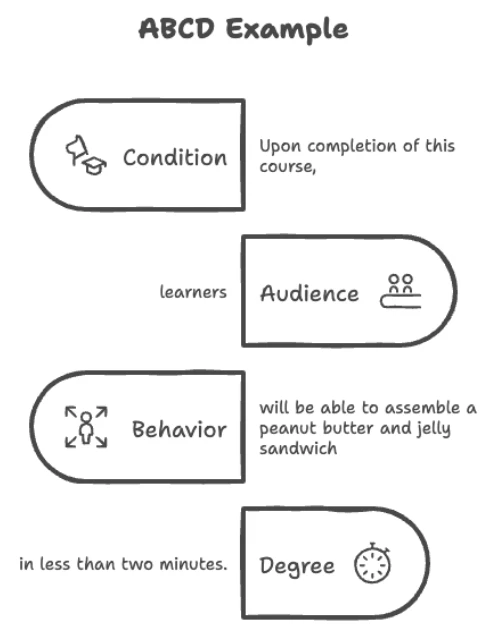
- A - Audience: Who is the training for?
- B - Behavior: What should they be able to do after the course?
- C - Condition: Under what circumstances will they perform the action?
- D - Degree: How well do they need to do it?
Before: Students will understand peanut butter and jelly sandwiches. (Too vague!)
After: Upon completion of this course, learners will be able to assemble a peanut butter and jelly sandwich in less than two minutes. (Notice how A, B, C, & D don’t have to be in order!)
#2 - Go Beyond 'Know': Aiming Higher with Bloom's Taxonomy
Words like "know" and "learn" are forbidden in the world of objectives because you can't measure them. This is where Bloom's Taxonomy comes in, giving you a toolkit of active verbs that challenge learners on a deeper level.
- To show they Remember, ask them to: define, list, recall.
- To show they Apply, ask them to: demonstrate, solve, implement.
- To show they Create, ask them to: design, construct, develop.
By aiming for higher-order thinking, you build skills that stick. Check out some example verbs we use:.

#3 - The Big Picture & The Building Blocks: Terminal vs. Enabling Objectives
Great courses are built in layers. Structuring your objectives helps you create a logical and effective learning journey.
- Terminal Objectives are your big-picture goals. They are what a learner can do when the course is totally done.
- Example: Upon completion of this course, learners will be able to assemble a peanut butter and jelly sandwich in less than two minutes.
- Enabling Objectives are the smaller, stepping-stone skills needed to reach the main goal. They are your module-level objectives.
- Example: Differentiate between different types of breads.
- Example: Identify types of jellies and jams appropriate for PB&J sandwiches.
- Example: Combine ingredients between two pieces of bread with equal parts jelly and peanut butter.
Breaking it down this way ensures you don’t miss any critical steps, setting your learners up for a win.
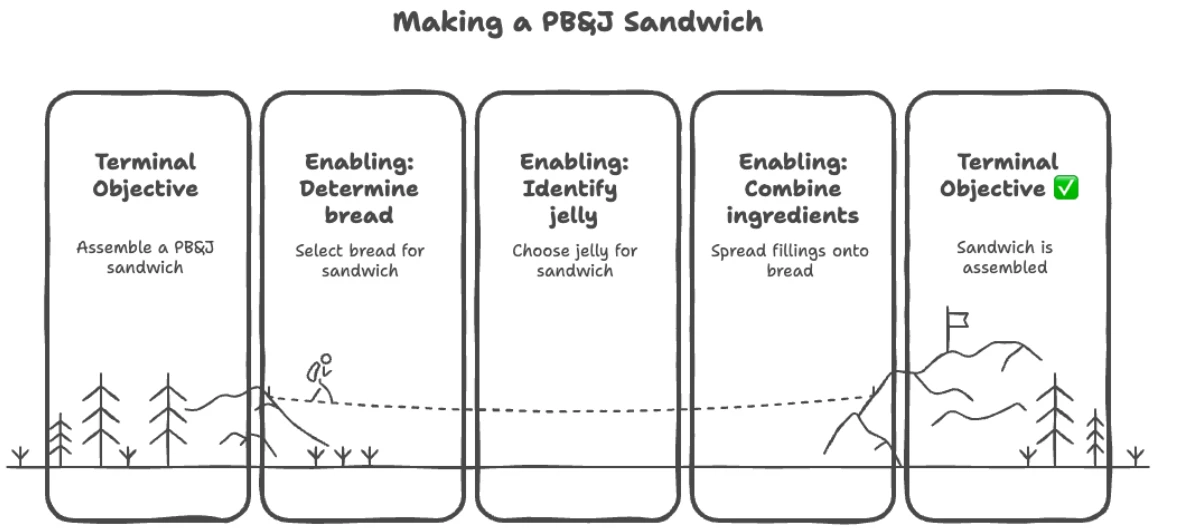
You can include this in your learning materials to clearly convey to your learners what they can expect. Below is an example of how Docebo uses this style of learning objectives in our live ILTs.

Take it One Step Further Using AI
There are numerous models out there for structured prompting. Here at Docebo, we use this model when doing structured AI prompts: Task, Context, Goal, Reference, and Constraint.
With the AI tools at your disposal, try a prompt like the below to utilize the tips you learned today with higher efficiency:
[TASK]
Generate a set of learning objectives based on the provided reference text.
[CONTEXT]
You are an expert instructional designer. I have been given a piece of content directly from a Subject Matter Expert (SME), and I need to use it to build a structured training course for adult learners. The first step is to define what the learners will be able to do after completing the course.
[GOAL]
To produce a set of clear, measurable, and well-structured learning objectives that will form the foundation of the new training course.
[REFERENCE TEXT]
Paste the complete content provided by your SME here. For example:
"[SME content on how to bake a multi-layer cake, including ingredient lists, mixing techniques, baking times, and assembly instructions...]"
[CONSTRAINTS]
You must follow these specific rules when creating the objectives:
- Structure: Create one overarching Terminal Objective and a logical list of the Enabling Objectives required to achieve it. The Terminal Objective should be the main, big-picture goal of the course that a learner can achieve upon completion. The list of Enabling Objectives should be the smaller, stepping-stone skills and knowledge needed to achieve the terminal objective.
- Framework: Every objective, both terminal and enabling, must be written using the ABCD model. The ABCD method defines the Audience (the learner), Behavior (a measurable action they can perform), Condition (the circumstances for the action), and the Degree (the standard of performance).
- Verb Choice: All "Behavior" components must use active, measurable verbs drawn from Bloom's Taxonomy. Do not use vague verbs like "understand," "know," or "learn."
Now that these tools are in your toolbelt, we hope they help you with your content creation. Happy Learning!