I am looking for input and hints on documenting your Docebo deployments. Over the past year I have gained more and more functions. I am looking for hints and ideas, “where to begin” in documenting our current build.
I need to get a hold of plans and designs on everything from branches, groups, catalogs, etc while cleaning up CLOR and others.
Any ideas are very helpful.
Best answer by KMallette
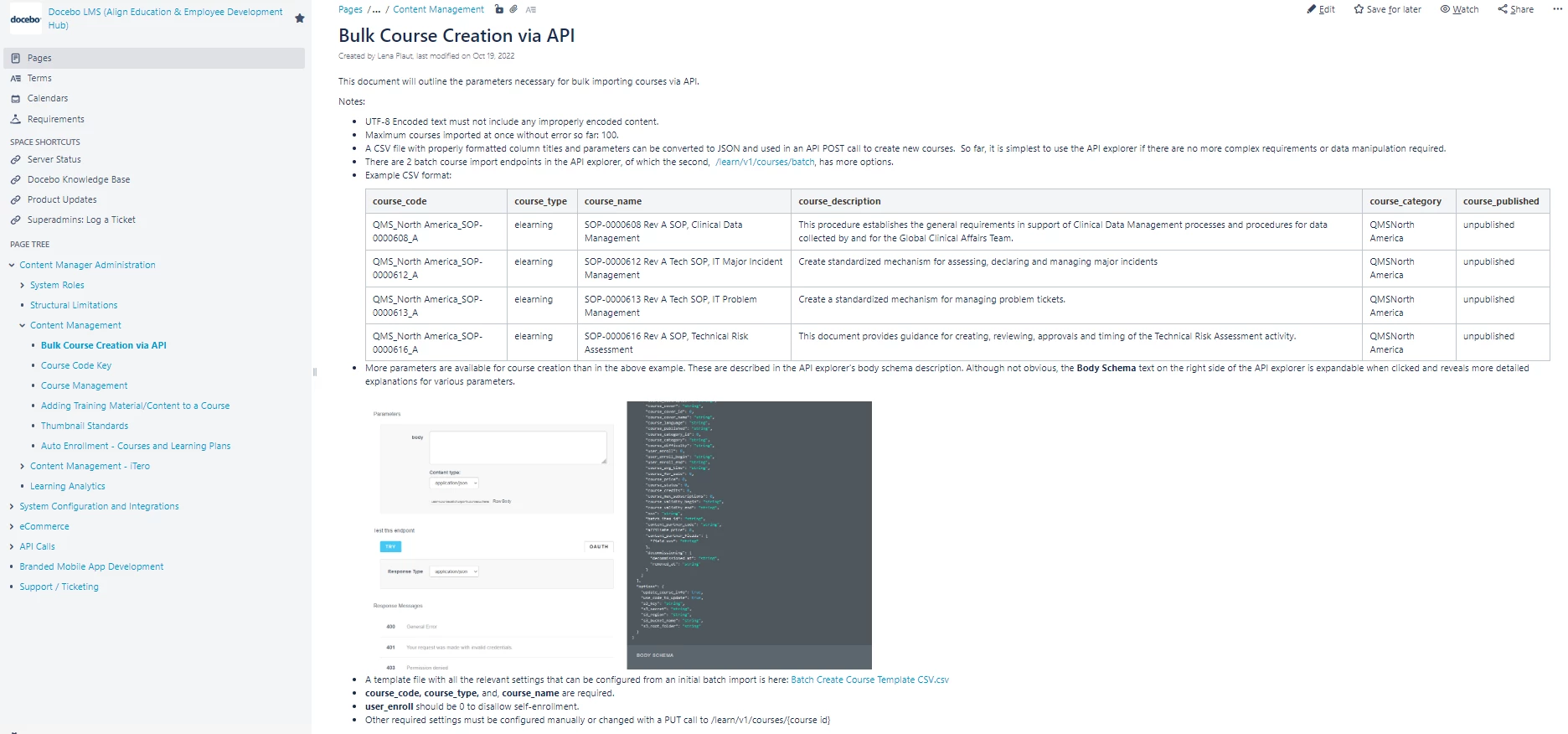
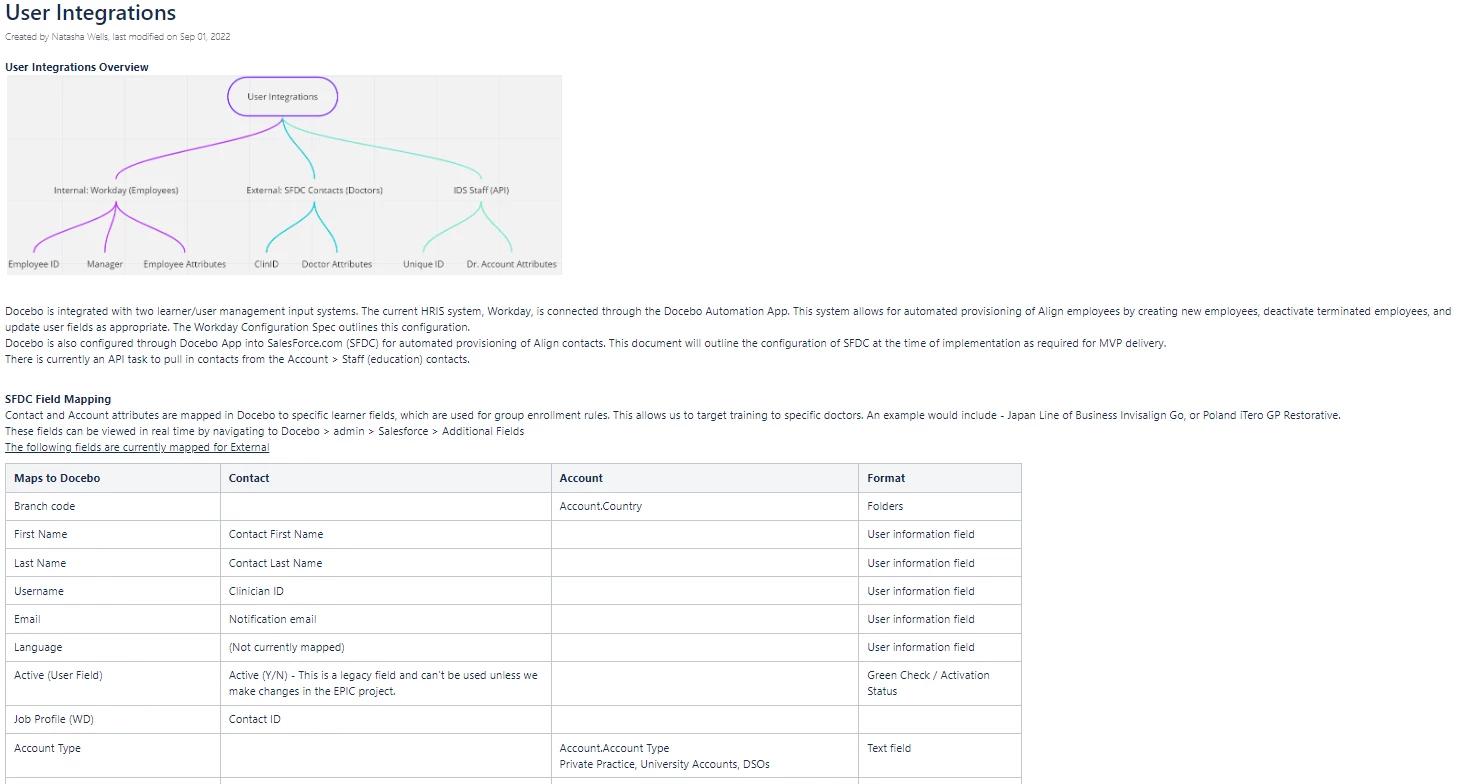
@Feenix73 I’ve used a wiki site… separate pages for each of my EE configurations, which then have sub-pages for various audiences (agents, partners, etc.) that show me the catalogs, the learning plans, and the courses, and the languages available for the courses On the same page I also track the branch and group visibility. I stuff as much info into a page as I possibly can.
@Feenix73 I’ve used a wiki site… separate pages for each of my EE configurations, which then have sub-pages for various audiences (agents, partners, etc.) that show me the catalogs, the learning plans, and the courses, and the languages available for the courses On the same page I also track the branch and group visibility. I stuff as much info into a page as I possibly can.
@Feenix73I’ve used a wiki site… separate pages for each of my EE configurations, which then have sub-pages for various audiences (agents, partners, etc.) that show me the catalogs, the learning plans, and the courses, and the languages available for the courses On the same page I also track the branch and group visibility. I stuff as much info into a page as I possibly can.
Good luck!
KMallette/Viasat, Inc.
That’s a great solution - Microsoft Teams has wiki pages, so I could try this out...
I must admit we are just about to launch ILT on Docebo, we have been using it for eLearning for 4 years now. I am using teams and SharePoint to document and provide how to guides. the eLearning deployment was relatively simple it with ILT it seems to be much more complicated. If you have the Microsoft SharePoint environment, then it is quite easy to set up and control who has what access to your documents.
@Feenix73I’ve used a wiki site… separate pages for each of my EE configurations, which then have sub-pages for various audiences (agents, partners, etc.) that show me the catalogs, the learning plans, and the courses, and the languages available for the courses On the same page I also track the branch and group visibility. I stuff as much info into a page as I possibly can.
Good luck!
KMallette/Viasat, Inc.
That’s a great solution - Microsoft Teams has wiki pages, so I could try this out...
I use a teams site broadly, combination of SharePoint lists, wikis or onenotebooks(my preference), documents pinned as tabs, forms that let admins trigger api based processes, usage logs, groupings, etc. different channels for different focuses. Also remember the channels each have a dedicated email address, so can send like status messages from vendors and such, all in one place.
I desperately need to document but I’m flying by the seat of my pants probably until March.
On the plus side, excellent job security for me.
Just don’t peeve anybody off too much as you roll out 😁 and you should be ok. I think that you should have a few fundamental docs to get you going. Then beyond that? At the close of your first year? Setup a documentation project for yourself and go back and write up all kinds of key things.
I desperately need to document but I’m flying by the seat of my pants probably until March.
On the plus side, excellent job security for me.
Just don’t peeve anybody off too much as you roll out 😁 and you should be ok. I think that you should have a few fundamental docs to get you going. Then beyond that? At the close of your first year? Setup a documentation project for yourself and go back and write up all kinds of key things.
Sound sa lot like all the projects I watch that are always “We will get to that x at X” and the can always seems to get kicked…..
Personal observation on dozens of implementation projects is yes, it can feel like extra un-needed work, but in the long run it actually saves time for things like onboarding support, miscommunication with leadership, and not getting a call for absolutely everything. If viewed as a giant monolith, it always gets put up, if done in small pieces in real time, typically at least gets done to a degree.