

Question

Language. equivalents of courses

  • April 1, 2025
  • 6 replies
  • 63 views

Forum|alt.badge.img

We offer courses for external clients. For each client and course, the number of participants is limited.


Some clients require access to the same course in multiple languages, but they are unable to predict in advance how the number of participants will be distributed across these language versions.


I had the idea to solve this by introducing course equivalents. Ideally, the course displayed to the user should depend on the selected platform language. Regardless of which language version is used, there should be a fixed number of user licenses that can be flexibly distributed across the course equivalents.


Has anyone had experience with such an approach? Is this technically feasible, or is there possibly a better solution?


Kind regards

6 replies

lrnlab
Hero III
Forum|alt.badge.img+10
  • Hero III
  • April 2, 2025

Hi yes you can do that but keep in mind when using equivalencies, all linked courses will appear in the user transcript and you cannot identify which course they actually completed as they all show with the same status (there is no status for “credit by equivalency”). The only thing that differentiates a course that was actually completed vs. not, is the time spent in the course.

Another approach would be to place all your training objects in a single course and mark them all as ‘end object markers’ so that the user can complete whichever one they want. Haven't tested to see if they can go back and redo the other learning objects - that would be a good scenario to test if you like this option. 

Docebo is working on a version of multi-language courses but not sure we’ll see that this year. See the product roadmap for more details.


Forum|alt.badge.img
  • Author
  • Novice III
  • April 23, 2025

Thank you for your answer and suggested solutions. I have indeed found it on the roadmap. But yes, it still seems to be a long way off.
Unfortunately your first solution does not work. A main criterion for me is that the number of enrollees for both languages must be added and kept below a limit. I offer the courses for external customers who don't know whether 100 or 120 or ... out of a total of 300 course accesses are used by English-speaking users. That's why they want to buy 300 accesses, which can then be distributed among the courses, as long as the total remains =< 300 users. Unfortunately, adding them up does not work.

Your second solution, to move all training materials (i.e. both languages) to one course and then let the user choose, is unfortunately unfavorable, as I sometimes have >10 training materials, which then quickly becomes confusing. I also can't do without mutual prerequisites.

So I'm afraid I'll have to improvise somehow and wait longingly for the actual multi-language support... 


lrnlab
Hero III
Forum|alt.badge.img+10
  • Hero III
  • April 23, 2025

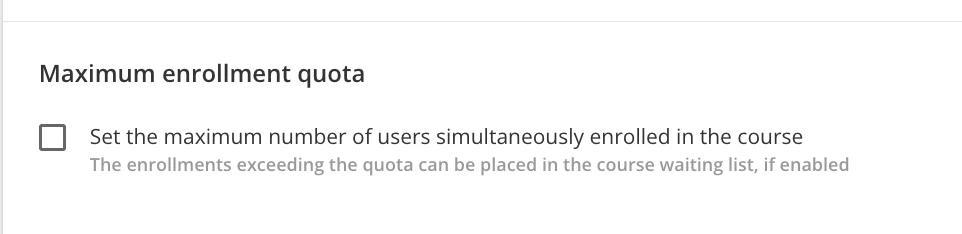
If you go the 1 course route, you can create folders to organize your content and then use the “Max enrolment quota” setting to block enrolments beyond a certain number. It’s under the Catalogue Options tab of the course


Forum|alt.badge.img
  • Author
  • Novice III
  • April 23, 2025

That is correct. However, it does not solve my specifications regarding the training material prerequisites. This also applies to tests that lead to passing the whole course. Putting both languages in one course would, in my experience, cancel that out. 


lrnlab
Hero III
Forum|alt.badge.img+10
  • Hero III
  • April 23, 2025

you set pre-reqs between training objects and I think you can still apply that within the folders. You can then make each test (or the thing that marks the course as completed) as the “end object marker”. There can be one for each language in each folder. Would that help?


Forum|alt.badge.img
  • Author
  • Novice III
  • April 24, 2025

thanks for your persistence. i actually have a workaround now, which is not perfect, but will suffice until multi language support is developed.

the challenge for me is that i have several tests per course, all of which require their own course materials. all tests have to be passed in order to complete the entire course.

i have now created two folders, german and english. i have assigned the course material to each of them and created tests. however, they no longer have any mutual prerequisites (to prevent contradictions or duplication with the other language).
I then created a final course material in each language, which requires that all tests in the respective language have been passed. these two materials are also final course markers. so the user takes the tests in his language, passes them, and is only then allowed to open the “completion”, which means he successfully completes the course and receives his certificate. i was even able to assign the certificates to the languages, as german and english-speaking users are automatically assigned to the user group “german” or “english” when they register, so that i now distribute the english certificate for the english-speaking users in addition to the german standard certificate.
only the course name and short description can apparently not be entered for two languages. this is a pity, but the least of the problems.