


Question

What video platform do you use? As Vimeo is increasing their price by 500%

  • Nov 4, 2026 4:37 PM UTC
  • 1 reply
  • 15 views

Forum|alt.badge.img+6

Hi everyone! Vimeo has been our video platform for a long time and it has been great uploading training material into our Docebo platform. However, this month, we found our that Vimeo (who has been acquired by Bending Spoons) decided to change our plan and will have to renew in December 2026 under the Studio plan and the cost increased by 500%.

We were wondering what video platform do you use? As we are looking to move all our videos off of Vimeo and trying to find the best way to do this.

This is what we found out on the internet about Vimeo being acquired by Bending Spoons. Watch these video links below.

Vimeo has become significantly more expensive due to its acquisition by Bending Spoons in late 2025 and a major restructuring of its subscription tiers and bandwidth limits. 

The Bending Spoons Takeover

  • Private Acquisition: Bending Spoons—an Italian tech company known for buying established software, cutting staff, and driving up profits—acquired Vimeo for $1.38 billion. 
  • Staff Layoffs: Following the buyout, Vimeo underwent major internal layoffs in January 2026, gutting product and support teams. 
  • Aggressive Monetization: The new ownership replaced legacy Plus, Pro, and Business tiers with sharply higher-priced self-serve and enterprise options to extract higher contract values
  • Forced Upgrades and New Plan Rules
  • Discontinuation of Legacy Plans: Longtime subscribers on older, cheaper plans are being automatically migrated to new, more expensive tiers upon renewal. 
  • Bandwidth and Storage Caps: Accounts now face strict monthly bandwidth caps (such as 2 TB), and exceeding them forces users into high-cost Enterprise or custom Studio plans. 
  • Loss of Features on Lower Tiers: Attempting to downgrade to a cheaper tier strips away vital tools like password protection, custom players, brand removal, and folder collaboration. 

According to reports on PetaPixel, Vimeo now unilaterally reclassifies users based on how they use the platform, sometimes pushing individual creators or small businesses into commercial or enterprise brackets that jump from a few hundred dollars a year to several thousand. 


This video breaks down the recent changes to Vimeo's pricing structure and how the acquisition is impacting creators:


https://youtu.be/HD2LS5gdNF4?si=ssoLqBicUEzoA7Q7


https://share.google/eLEsYmJ2D5hNeKCy7


https://www.linkedin.com/posts/joel-anderson-mental-health-advocate_public-service-announcement-for-anyone-who-activity-7485089746860539905-Snet


After watching these videos above, it looks like Vimeo will end. 

Docebo's built-in "Embed video URL" feature currently only recognizes YouTube, Vimeo, and Wistia and they need to have more than these 3 options.
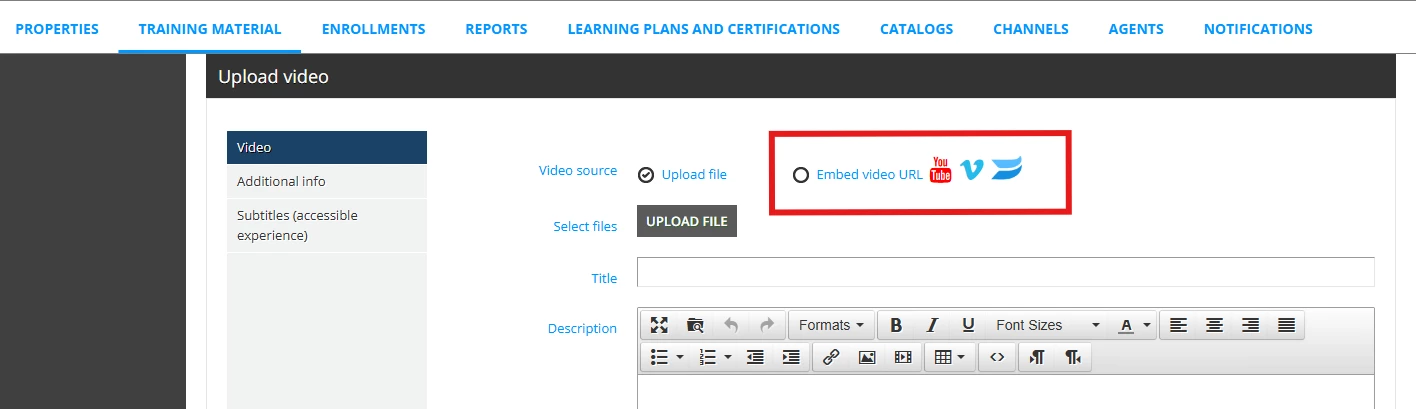



1 reply

Moshe.Machlav
Guide I
Forum|alt.badge.img+2

Before migrating your entire library to another paid third-party video host, have you evaluated moving your standard training videos directly into Docebo’s Central Repository (CLOR) as native MP4 files? Unless you rely on external public sharing outside the LMS, native hosting eliminates third-party bandwidth caps and renewal spikes entirely.

When I've helped organizations migrate off Vimeo recently, the pattern that holds up best is splitting the video library into three buckets based on how the content is actually consumed:

1. Direct MP4 Upload to the Central Repository (Zero Extra Cost): For 80–90% of standard training videos, uploading the MP4 directly via Admin Menu > E-Learning > Central Repository (or directly inside a course via Add Training Materials > Video > Upload File) is the cleanest path. Docebo supports video files up to 1,024 MB (1 GB) per Learning Object, handles adaptive streaming natively, and tracks completion automatically (either at 90% watched for videos under 150 seconds, or 15 seconds before the end marker for longer videos). Updating a video in the CLOR automatically updates it across every course where it is linked.

2. Wistia (Best Native Drop-In Replacement for External Hosting): As you noted, Docebo’s built-in Embed video URL feature natively supports only YouTube, Vimeo, and Wistia. In organizations I've worked with that still require an external video management platform for marketing alignment, domain-level allowlisting, and built-in timeline Chapters, Wistia is the most reliable native alternative because it works directly with Docebo's standard video completion tracking without custom workarounds.

3. Camtasia (SCORM) or H5P (For Interactive Chapters Without Recurring Bandwidth Fees): If the main reason you kept Vimeo was for timeline markers, chapters, or interactive navigation, you can bypass recurring video SaaS fees altogether. Packaging videos in Camtasia (using timeline markers/table of contents exported as SCORM) or H5P lets you upload the package directly into Docebo's CLOR with rich chapter navigation and granular tracking—completely free of external bandwidth limits.

For reference on native URL support, completion criteria, and file limits, check the official documentation:

If you share roughly how many videos you need to migrate and whether you use Vimeo just for playback or for chapter navigation/external sharing, I'd be happy to share the fastest migration workflow.